Brazil Visa Requirements: Who Needs One and How the eVisa Works
The rules for entering Brazil changed in April 2025. If you hold a US, Canadian, or Australian passport, you need a visa again, a quick online one; anyone who visited between 2019 and 2025 walked in without one. If you are British or European, you still do not. And the first "Brazil visa" site your search engine offers is not necessarily the official one, which matters when you are about to type in your card number.
We are Brazilian, so we have never applied for a Brazil visa ourselves. This guide comes from the official rules and from the visiting friends we have walked through the process. Here is the whole picture in one place: who needs a visa in 2026, how the eVisa actually works, how long you can stay and how to stretch it, what airlines and border control really check, and the yellow fever question.
TL;DR
US, Canadian, and Australian passports need an eVisa (since April 2025). Apply only at brazil.vfsevisa.com
UK, EU, Japanese, and most Latin American passports: no visa for stays up to 90 days
Tourists get 90 days. Some nationalities can extend to 180 at the Federal Police; EU passports cannot
No vaccine certificates required at the border, but a yellow fever outbreak is running in 2026, so get the shot for most itineraries
Airlines often want to see an onward ticket before they let you board
Do you need a visa to visit Brazil?
It depends on your passport, and only on your passport. Brazil sets entry rules country by country, mostly on reciprocity, so what the person next to you in the boarding line needs may be different from what you need. The same rules cover tourism and short business trips alike.
- United States, Canada, Australia: you need a visa, reinstated on April 10, 2025 after a six-year break. The good news is that it is an eVisa, done entirely online, with no consulate visit. The whole next section is about it.
- United Kingdom: no visa. You get up to 90 days as a tourist, and you can apply inside Brazil to extend it, up to a maximum of 180 days in a 12-month period.
- European Union and most of Europe: no visa for up to 90 days, counted within a rolling 180-day window, the same math Schengen applies to Brazilian visitors. There is no extension; staying longer means a proper long-stay visa. Brazil has applied that cap to EU passports since 2012, so if you read that it changed in March 2026, what changed was the wording of the agreement, not the rule.
- Japan, New Zealand, and most of Latin America: no visa for up to 90 days. Citizens of South American neighbors like Argentina, Uruguay, and Chile do not even need a passport; a national ID card is enough at the border.
- China: no visa, but on different terms. Brazil waived the requirement for ordinary Chinese passports on May 11, 2026, reciprocating China's own move, and it covers 30 days rather than 90, with no extension. The measure is set to run until December 31, 2026, so check it has been renewed before you book a later trip.
- Everyone else: if your country is not covered by an exemption (India is the biggest one that is not), you need a consular visa arranged through the nearest Brazilian consulate before you travel. Start early; consular timelines are their own adventure.
If you are unsure which bucket you fall into, your airline and the nearest Brazilian consulate both work from the same official table, and the consulate's website will state it plainly.
How does the eVisa work for US, Canadian, and Australian citizens?
First, the single most important detail: the only official application site is brazil.vfsevisa.com, run by VFS Global on behalf of the Brazilian government. Search results are crowded with lookalike agency sites that will file the same form for a markup, or worse. Type the address yourself.
- What it costs: 80.90 US dollars per traveler as of mid-2026, paid online by card. Children need their own eVisa at the same fee, and the fee is not refunded if the application is denied.
- What you upload: a color scan of your passport's photo page and a recent passport-style photo against a light background. Depending on your answers, the system may also ask for supporting documents, like flight or accommodation confirmations, or a recent bank statement.
- How long it takes: decisions often come back within a few days, but official guidance allows around 10 business days, and complicated applications can take longer. Apply at least two to three weeks before flying, and earlier if you are coming for Carnival or New Year's, when everyone else is applying too.
- How long it lasts: 10 years for US citizens and 5 years for Canadians and Australians, or until your passport expires, whichever comes first. It is a multiple-entry visa: get it once and it covers every trip in that window, with up to 90 days per visit and a cap of 180 days in any 12-month period.
- At the airport: the approved eVisa arrives by email as a PDF. Keep it on your phone and carry a printed copy too; check-in staff will ask for it, and a paper backup has saved more than one dead battery.
One more scenario worth spelling out: connections. If your itinerary only touches Brazil for a layover, do not assume you can skip the visa. Brazil's requirement applies regardless of the purpose of travel, there is no airside transit exemption you can count on, and the person deciding whether you fly is a check-in agent following the airline's rulebook. If Brazil is on the ticket at all, have the eVisa. (Visa-free passports have nothing extra to arrange for a connection.)
How long can you stay in Brazil (and can you extend)?
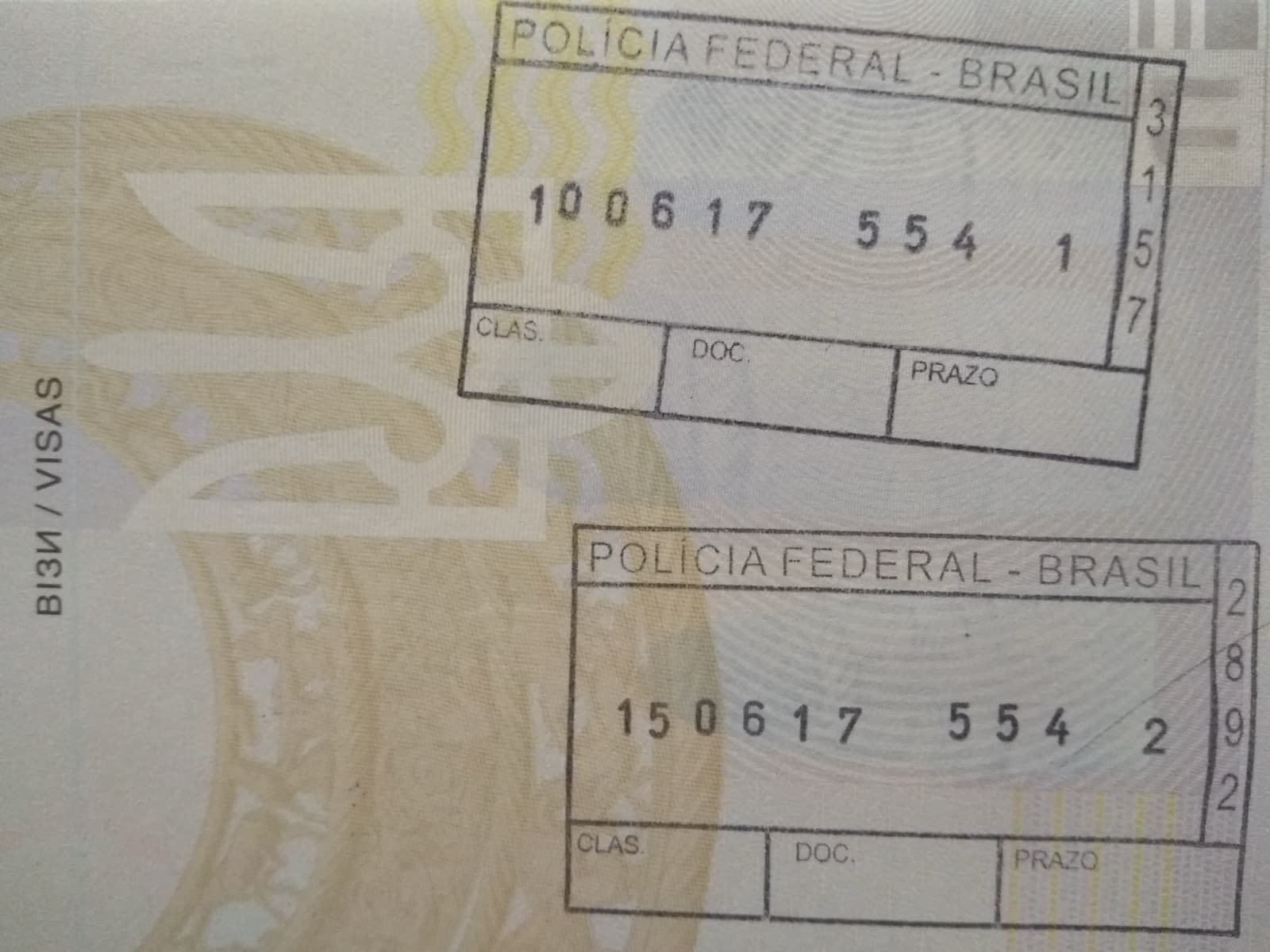
At the border, the Federal Police (Polícia Federal, Brazil's border authority) will admit you for up to 90 days as a visitor. The clock starts the day you enter, and the stamp in your passport is the proof of when that was.
If 90 days will not be enough, some nationalities can extend without leaving the country. US, Canadian, Australian, and UK passport holders are among those who can; EU passports cannot, since the waiver agreement fixes the 90-in-180 window. Extending means a visit to a Federal Police office before your first 90 days run out: book the appointment online, bring your passport, an onward ticket, proof you can support yourself, and the paid fee of about R$110 (about US$22) (the 2026 rate). Granted in full, the extension takes you to 180 days in a 12-month period, which is also the absolute ceiling for tourists however you split your trips. Appointment slots in Rio and São Paulo go fast, so do not leave it for the final week.
Overstaying is a bad deal. The fine is R$100 (about US$20) for every day past your limit, capped at R$10,000 (about US$2,000), and it is charged when you leave or when you next try to come back. The fine is the good outcome; the record it leaves in the immigration system is the part that can complicate future trips.
And if your plans are bigger than a tourist stay: Brazil has a digital nomad visa for remote workers on foreign income, plus the usual work and study visas. Those are consular processes with their own document lists, so start with the Brazilian consulate that covers where you live.
What do airlines and border control actually check?
The border itself is usually quick and friendly. The place your paperwork really gets inspected is the check-in desk back home, because the airline pays the bill if it flies you to Brazil without the right documents. Here is what gets looked at:
- Your passport: Brazil's own bar is low (the US State Department's wording is that it must simply be valid on the date of entry), but the UK government tells its citizens to have six months of validity from arrival, and airline agents often apply the strictest reading in their system. If you are inside six months, renew before you fly and skip the discussion entirely. You also want at least one fully blank page for the stamp.
- An onward or return ticket: Brazilian officers ask for it unevenly, but airlines check it for them at boarding, and a missing onward ticket is one of the more common reasons people get pulled out of a check-in line. Have a real booking that shows you leaving Brazil within your allowed stay.
- Money and an address: immigration can ask how you will support yourself and where you are sleeping, though with tourists they rarely do. Keep your first hotel's name and address handy for the forms and the occasional question. A regular credit card settles the money question; for how you will actually pay for things once you are inside, see our guide on paying and tipping in Brazil.
- The stamp: check your passport before you walk away from the booth. That little Polícia Federal rectangle is your proof of legal entry, and the UK government warns its citizens that leaving without one can mean a fine on the way out. If an officer waves you through an unfamiliar gate or the ink is a smudge, ask.
Do you need any vaccines to enter Brazil?
At the border, no. Brazil does not require proof of any vaccination to let you in, yellow fever included, no matter which country you are arriving from.
Required and recommended are different things, though. Health authorities, including the US CDC, recommend the yellow fever vaccine for most of Brazil: that covers Rio de Janeiro and São Paulo (cities included), Minas Gerais, Brasília, Iguaçu Falls, the Pantanal, and the entire Amazon region. The exceptions are states, not cities: the vaccine is not recommended for Ceará, Rio Grande do Norte, Paraíba, Pernambuco, Alagoas, or Sergipe, which is where Fortaleza, Natal, Recife, and Maceió sit. Bahia is split between the two, so if Salvador is on your route, that one is worth looking up. The shot needs to go in at least 10 days before travel to count, so this is a book-it-now errand, not an airport one.
That recommendation carries more weight than usual right now, because Brazil is working through a yellow fever outbreak. As of late July 2026, health authorities had confirmed 15 cases and eight deaths, most of them in São Paulo state, and the CDC has Brazil under a Level 2 travel notice. Most of the people who fell ill were unvaccinated. If your last yellow fever shot was more than ten years ago and your route crosses an affected area, ask your travel clinic whether you should have a booster.
There is also a detail seasoned South America travelers know: while Brazil will not ask for the certificate, several other countries will ask for it because you came from Brazil. If your trip continues elsewhere on the continent or beyond, carry the yellow vaccination card. For everything else, a travel clinic visit four to six weeks before departure is enough to get the routine boosters sorted.
What if you or your kids are also Brazilian citizens?
Brazil treats its citizens as Brazilian first, whatever other passports they hold. If you have a valid Brazilian passport, that is the simplest way in: you travel on it, you need no visa, and nothing in the eVisa section above applies to you.
If yours is expired or will not be renewed in time, a consulate can issue a visitor visa in your foreign passport instead, on the same terms and for the same fee as anyone else of that nationality, which for an American, Canadian, or Australian passport means the ordinary eVisa. Carry a Brazilian document anyway, even an expired one, and show it at the booth. That is what gets you registered as Brazilian, with no clock on your stay; enter on the visa alone and you are admitted as a foreigner, with a foreigner's 90 days, in your own country.
The rule that genuinely catches families out involves children. Any minor who is a Brazilian citizen, including kids with dual citizenship who have never lived in Brazil, needs authorization from both parents to leave the country, and that holds even when the child is traveling on a foreign passport. Traveling with only one parent, the child needs the absent parent's formal written authorization, or a standing annotation in the Brazilian passport that permits it. Airports enforce this at departure, and a missing letter has ruined the last day of many otherwise perfect trips. If this applies to your family, sort the paperwork with a Brazilian consulate well before you travel.
Here is the reassuring part: for most travelers, Brazil's paperwork is genuinely light. Most of the passports in this guide need no visa at all, and the ones that do need one online form and a fee. Sort the eVisa early if you need it, glance at your passport's expiry date, book the yellow fever shot if your route calls for it, and then get back to the decisions that actually deserve your energy, like when to go. We will see you on the other side of the stamp. Boa viagem! (Have a great trip!)
Want more practical tips for Brazil? Join our newsletter and get notified of our latest posts.