Power Plugs and Voltage in Brazil: Which Adapter to Bring and What to Check
Brazil did something unusual with its electricity. We standardized the plug: the whole country uses the same neat three-hole socket, a design you've probably never seen anywhere else. But we never standardized the voltage, which changes from state to state, city to city, and occasionally from one socket in the room to the next.
The good news is that for most travelers this is a five-minute problem. Nearly everything you carry (phone, laptop, camera, e-reader) charges happily anywhere in Brazil with nothing more than a cheap plug adapter. This guide covers what the Brazilian socket looks like, which adapter actually fits, where the country runs on 127V versus 220V, and the one category of device you genuinely need to be careful with.
TL;DR
Brazil uses its own plug, type N: two or three round pins. American, British and grounded European plugs don't fit.
Slim two-pin European chargers fit Brazilian sockets with no adapter at all.
There is no single voltage: Rio and São Paulo run on 127V; Brasília, Florianópolis and most of the Northeast run on 220V. Always ask where you're staying.
Phone and laptop chargers are dual voltage and work everywhere. Hair dryers, straighteners and kettles are the devices that fry.
Forgot your adapter? Any hardware store sells one for around R$10–R$30 (about US$2.00–6.00).
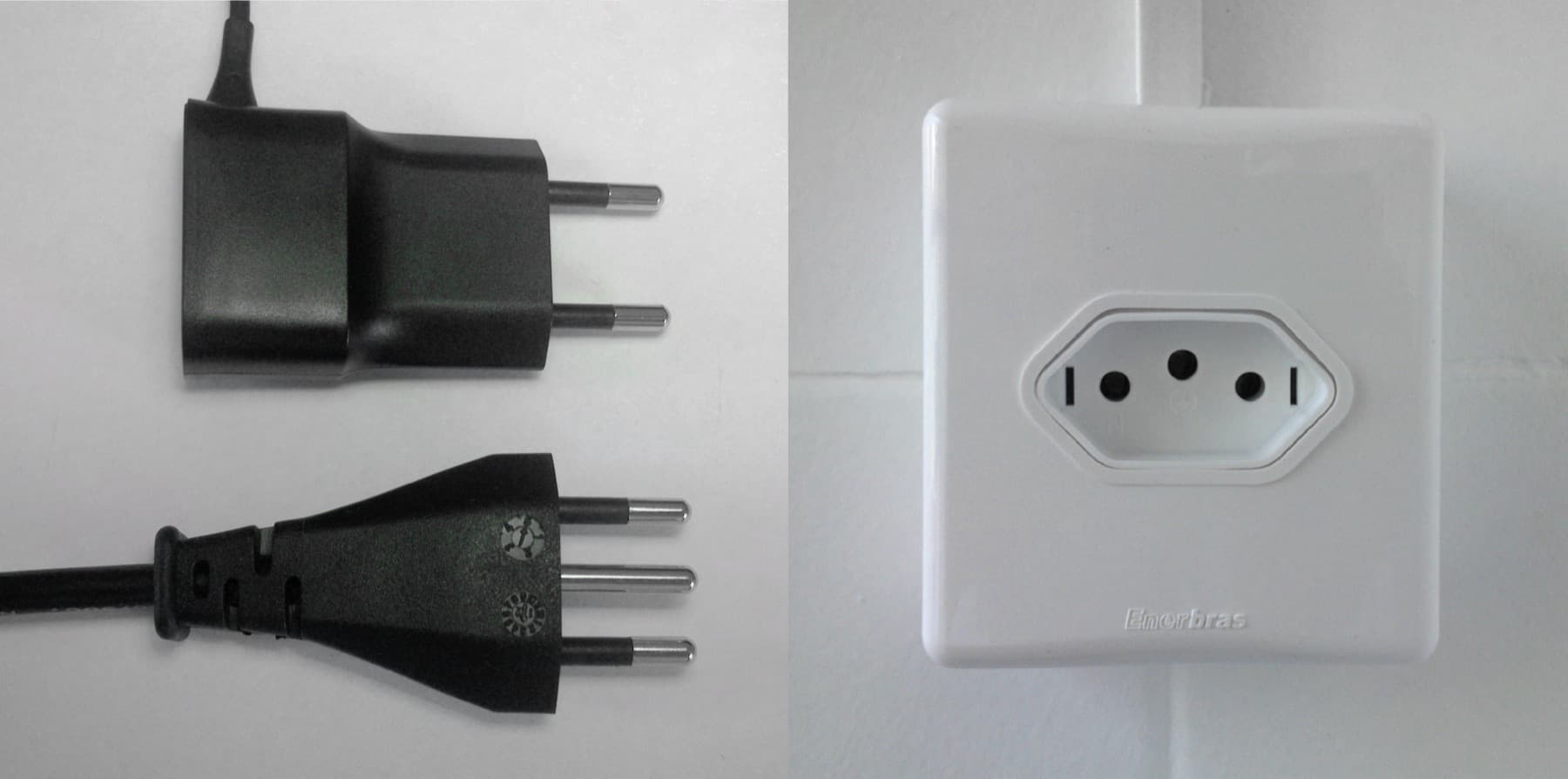
What do Brazilian plugs and sockets look like?
Brazil uses the type N plug: two round pins plus a grounding pin, sitting in a shallow recessed well in the wall. It's our own national standard (NBR 14136), based on an international "universal plug" design that almost nobody else adopted, so in practice you'll only run into it in Brazil and South Africa. It became mandatory here around 2010, so you will find it in any new or recently renovated building. Older buildings still have the old "universal" sockets, but don't plan your trip around this fact.
Which adapter do you need for Brazil?
It depends on where your devices are from:
- United States and Canada: flat-blade plugs do not fit type N sockets, so you need an adapter. Get one labeled type N (often sold as "Brazil and South Africa"). They're small and cheap, and we'd bring two: adapters have a real talent for staying behind in hotel rooms.
- Continental Europe: the slim two-pin charger plugs on your phone and shaver (the Europlug) fit Brazilian sockets directly, no adapter needed. The thick grounded plugs with side clips (Schuko) on laptop and appliance cords usually do not fit the common 10 A socket, so bring an adapter for those.
- UK and Ireland: the three big rectangular prongs fit nothing here. You need an adapter.
- A warning about universal adapters: many "all-in-one" universal adapters cover the US, UK, Europe and Australia and stop there, and on some of them the "EU" pins are the thicker 4.8 mm kind that won't go into most Brazilian sockets. Check that type N or Brazil is explicitly on the box before trusting one.
One packing trick we love: bring a small power strip from home. One adapter goes in the wall, and every charger you own plugs into something familiar. Many newer hotels also have USB ports by the bed, but never enough of them.
Is Brazil 110V or 220V? Both, and that's the catch
There is no national voltage in Brazil. Each state, sometimes each city, settled on either 127V or 220V back when the grid was built by different companies with different habits, and it was never unified. The frequency, at least, is 60 Hz everywhere, the same as North America.
Here's how it roughly breaks down for the places you're most likely to visit:
- 127V (locals call it "110"): Rio de Janeiro and its coast (Búzios, Paraty, Ilha Grande), São Paulo, Belo Horizonte, Salvador, Curitiba, Foz do Iguaçu, Porto Alegre, Manaus, Belém and Bonito.
- 220V: Brasília, Florianópolis, almost the entire Northeast (Fortaleza, Recife, Natal, João Pessoa, Maceió, São Luís, plus Fernando de Noronha and Jericoacoara), most of Bahia outside Salvador (including the Chapada Diamantina), and the Serra Gaúcha towns of Gramado and Canela.
- When in doubt, just ask. Front desks and Airbnb hosts answer this question every week. The phrase: "A tomada é cento e dez ou duzentos e vinte?" ("Is the outlet 110 or 220?"). Don't bother memorizing the list. Even Brazilians double-check before plugging anything in after a move.
What can you safely plug in?
This is the part that actually protects your gear. Flip your charger or device over and read the small print on the label:
- "INPUT: 100-240V ~ 50/60Hz" means you're fine anywhere in Brazil. Virtually every phone, laptop, tablet and camera charger made in the last decade is dual voltage like this. All it needs is the plug adapter.
- A label that says only 110-120V is the danger zone. Plug that into a 220V socket and it dies instantly, sometimes with a pop and a thin line of smoke. This is the classic ending for hair dryers, curling irons, straighteners and travel kettles.
- A 220-240V-only European device in a 127V city won't be damaged, it will just underperform. A hair dryer on half the voltage blows sad, lukewarm air.
The practical consequences:
- Leave high-wattage single-voltage devices at home. Voltage converters strong enough for a hair dryer are heavy bricks and not worth the suitcase space. Most hotels and many rentals provide a dryer (ask before you fly), and travel dryers and straighteners often have a small 125V/250V switch: set it before you plug in, not after.
- Check the kids' gear. White noise machines and bottle warmers are frequent single-voltage casualties.
Forgot your adapter? Here's what to do
Don't pay airport prices unless you're desperate. In order:
- Ask the front desk. Hotels everywhere keep a drawer of adapters left behind by other travelers, and Brazilian hotels are no exception.
- Walk into a hardware store or a big supermarket. Every Brazilian neighborhood has a hardware store, and a simple adapter costs around R$10–R$30 (about US$2.00–6.00). The phrase to use: "um adaptador de tomada, por favor" ("a plug adapter, please"). They take cards like everywhere else; see our guide on paying and tipping in Brazil if you're still setting that up.
- The airport kiosk, as a last resort. Electronics shops at GRU and GIG sell adapters, typically at two or three times the street price. Sometimes peace of mind is worth it.
Electricity is the least glamorous part of planning a trip to Brazil, and also one of the cheapest problems to solve: one small adapter, one question at check-in, one glance at the label on your hair dryer. Sort it out before you fly, like your SIM card, and your first morning here goes to the beach instead of a hardware store.
Want more practical tips for Brazil? Join our newsletter and get notified of our latest posts.