Lençóis Maranhenses: When to Go, How to Get There, and Where to Stay
Some links in this guide are affiliate links: if you buy or book through them, we earn a small commission at no extra cost to you. It never changes what we recommend. Here’s how we make money.
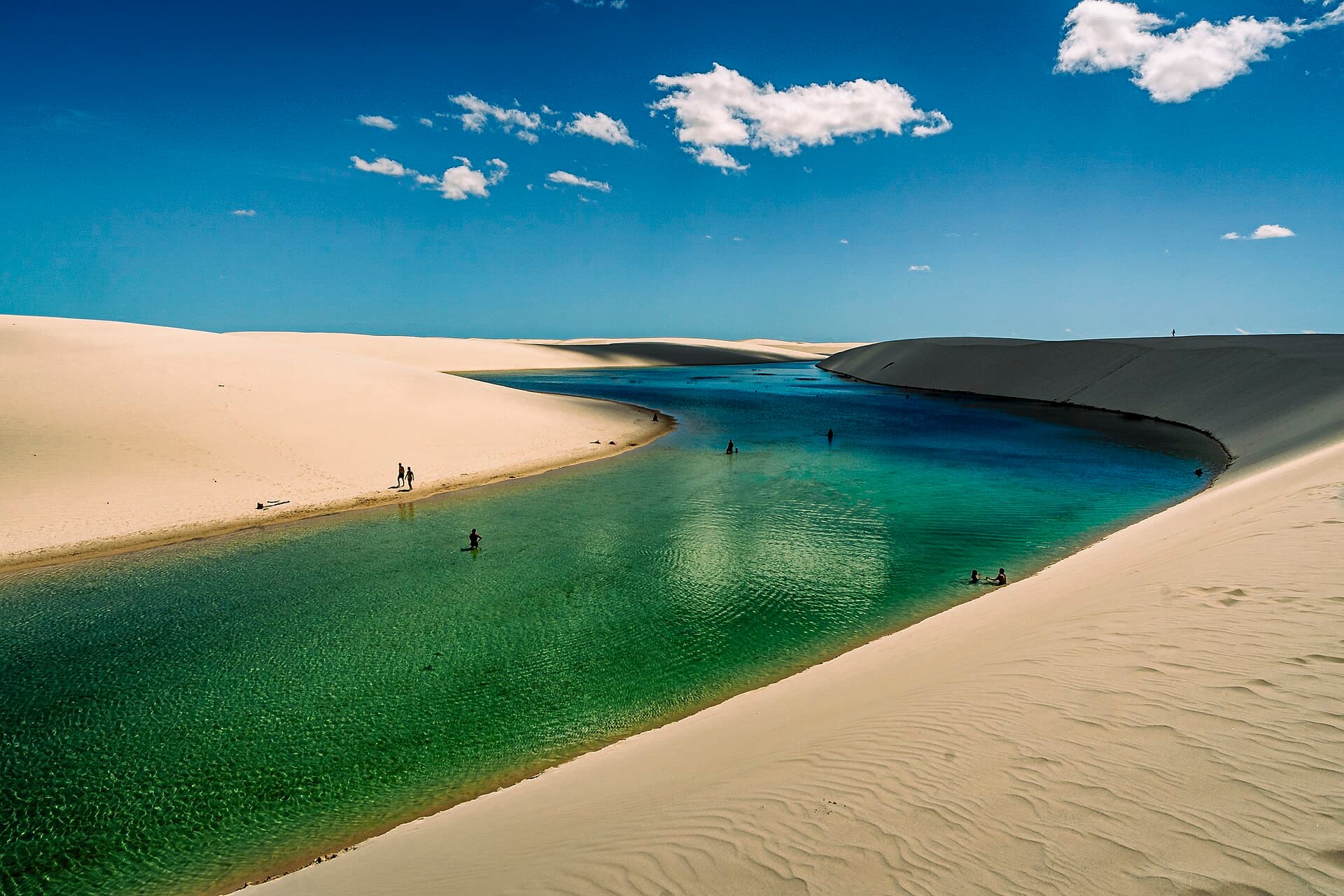
Lençóis Maranhenses is the Brazil from the photos that look retouched: white dunes to the horizon, and between them lagoons the color of a swimming pool. It is real, and it is one of the best things you can do in the country. The catch is that the lagoons are rainwater. They fill between January and May, hold through the middle of the year, and by November most of them are gone. Few places in Brazil punish a badly timed trip this hard.
It is also further from everything than it looks on the map. The nearest airport is in São Luís, four hours away by road, the park has no gates and no roads, and every visit is a bumpy ride in an open 4x4 truck with a local guide. Below we cover the months the lagoons are actually full, the flights and the road in, the three villages you can sleep in and how they differ, what the tours are like and what they cost, the park rules that changed in 2026, and what to pack for a place with no shade.
TL;DR
Go between late June and early September. The lagoons fill with the January-to-May rains and start shrinking from mid-September
Fly to São Luís, then four hours by road to Barreirinhas, the main base. Four nights there is the minimum we recommend: three days of tours and a day on the road at each end
Barreirinhas for convenience, Atins for charm and kitesurfing, Santo Amaro for the emptiest dunes
The park is free, but you can only enter with a credentialed guide in an authorized 4x4. Shared circuits run around R$120–R$180 (about US$24–36) per person in 2026
No shade, no ATM in Atins, patchy signal: pack for sun and carry cash
What are the Lençóis Maranhenses, and why go?
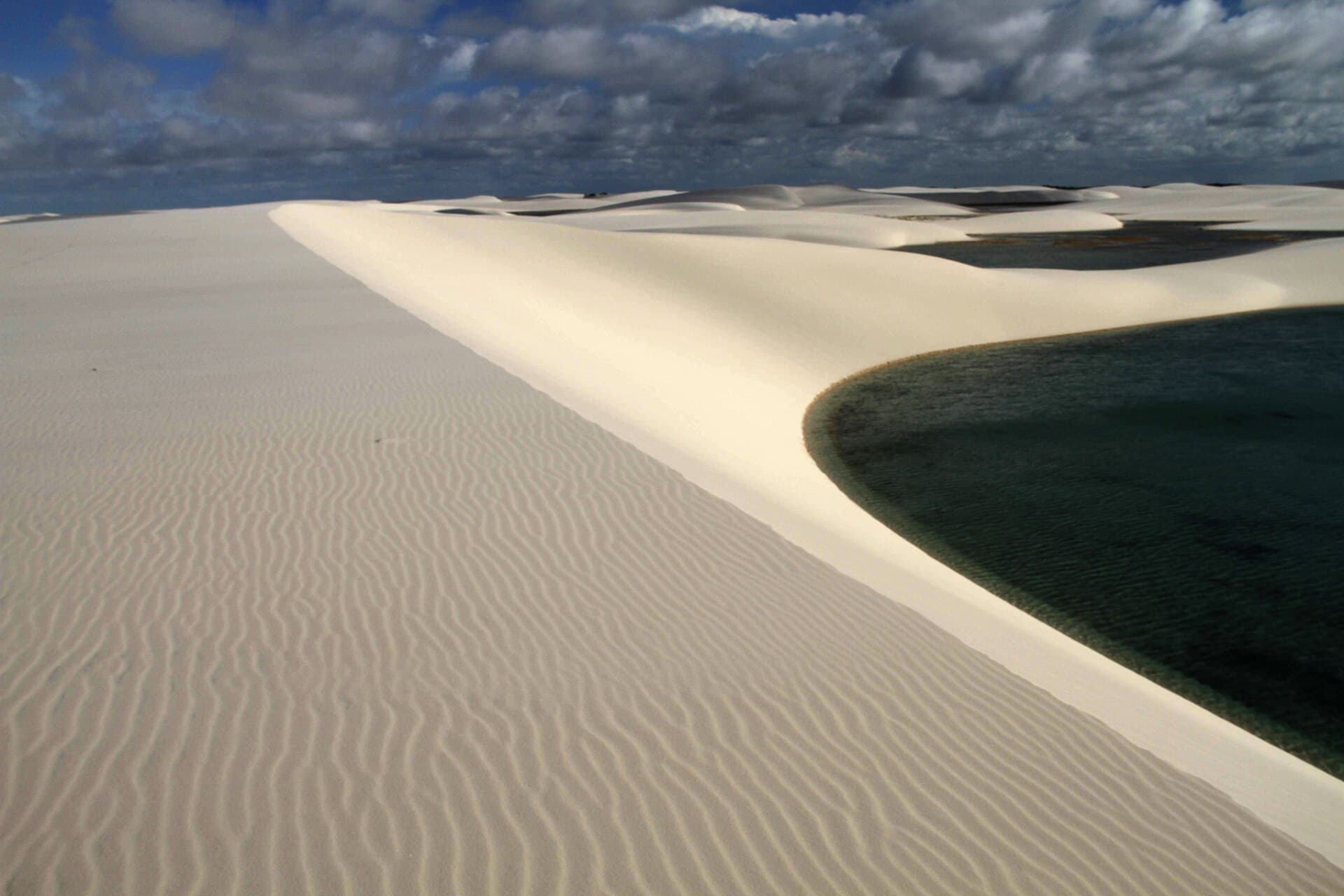
Lençóis means bedsheets, and from the air that is what the park looks like: a white sheet of sand thrown over the coast of Maranhão, in Brazil's northeast, and left rumpled. The dune field covers about 155,000 hectares along 70 kilometers of Atlantic shore, it has been a national park since 1981, and UNESCO added it to the World Heritage list in July 2024.
It looks like a desert, but it is not one. The region gets a lot of rain in the first half of the year, and the water collects in the valleys between the dunes and sits there on top of the water table. The result is thousands of freshwater lagoons, some of them hundreds of meters long, warm enough to spend an afternoon in and clear enough to see your feet. The dunes keep moving with the wind, so a lagoon your guide swam in last year may be a different shape this year, or gone. Two tiny communities, Queimada dos Britos and Baixa Grande, live on oases inside the park and put trekkers up in hammocks.
Honest version: this is a trip built around two or three half-day tours in a truck, a boat day, and a lot of sand. Heat is relentless, there is no shade, and the nearest big city is four hours away. If that sounds like a chore, it will be. If it sounds like an adventure, it is one of the most memorable places in Brazil, and we would put it on any first-trip shortlist alongside the Pantanal and Iguazu Falls.
When is the best time to visit Lençóis Maranhenses?
More than anywhere else in Brazil, the answer here is a date, not a mood. The lagoons only exist because of the rain, so the calendar decides what you will see:
- January to May: the rains. This is the wet season, and March and April are the wettest months, with more than 300 millimeters of rain each. The lagoons are filling, prices are low, and tours run on the dry days, but expect grey skies, flooded tracks and cancellations. Late May is when the lagoons reach their maximum.
- June: our pick. The lagoons are full, the rain tapers off, and the sun comes back before the July crowds do. Book ahead anyway, because Brazilians know this too.
- July: peak season. Full lagoons, blue skies, and the Brazilian school holidays, which fill the trucks, the pousadas (guesthouses) and the vans from São Luís. Reserve tours and rooms weeks in advance.
- August: still excellent. Dry, hot, full lagoons, and noticeably fewer people than in July. The wind picks up, which is what the kitesurfers in Atins are waiting for.
- September: a gamble that usually pays. In most years the lagoons hold well into the middle of the month, and after a wet season they last into early October. After a dry one, some are already fading in September. Our guide to the best time to visit Brazil picks September as the best all-round month for the country, and for the Lençóis it works as long as you go early in it.
- October to December: the dry season. Only the deepest, permanent lagoons still hold water, the rest are sand, and the wind can be fierce. The dunes are still beautiful, but this is not the trip in the photos. The rains return around the turn of the year.
Whatever the month, check the calendar of public holidays in Brazil before you book: a long weekend fills Barreirinhas fast.
How many days do you need?
Four nights in Barreirinhas is the minimum we recommend: three days of tours, one each for the Lagoa Azul circuit, the Lagoa Bonita circuit and the boat trip down the river to Caburé, plus a day at each end for the road to and from São Luís. The drive takes four hours and is exhausting, so do not plan a tour for a travel day. With five or six nights you can move on to Atins or Santo Amaro for two of them, which is what we would do. The trek across the park needs a week including the journey there and back.
How do you get to Lençóis Maranhenses?
Fly to São Luís. The capital of Maranhão has the only real airport in reach, and as of 2026 it has direct flights from São Paulo, Rio de Janeiro, Brasília, Belém, Fortaleza, Recife and Salvador, with LATAM, Gol and Azul between them. From São Paulo it is a little over three hours in the air. If you are coming from Europe, there is news: TAP starts a direct Lisbon to São Luís flight on October 26, 2026, twice a week and rising to three a week from March 2027, which turns the Lençóis from a long detour into a reasonable first stop in Brazil.
Barreirinhas, the park's main town, has an airstrip, and for a few years Azul flew small planes there. Those flights stopped in March 2025. In April 2026 the airport passed to a private operator with plans to expand it for commercial jets, but as of September 2026 it handles only private and charter flights, so plan on the road.
Then four hours by road. Barreirinhas is about 250 kilometers east of São Luís on a paved highway, and everyone does it one of four ways:
- Shared van transfer (our pick). Agencies run vans from the airport and the hotels straight to your pousada in Barreirinhas, timed to the flights. In 2026 a seat costs roughly R$95–R$130 (about US$19–26) per person, and the trip takes about four hours with a snack stop. Book it before you fly, and give the driver your flight number.
- Private transfer. The same trip in a car or van of your own runs about R$580 (about US$120) for up to four people in 2026, which for a family or two couples is barely more than the shared seats, and it leaves when you land.
- Bus. Cisne Branco runs several coaches a day from the São Luís bus station to Barreirinhas for about R$75 (about US$15), taking around five hours. It is the cheapest option, but we do not recommend it: the bus station is across town from the airport, and you still need a moto-taxi at the other end.
- Rental car. The road is fine for a normal car, but a car buys you very little here. Private vehicles are not allowed inside the park, every tour picks you up from your pousada, and Atins and Santo Amaro are reached by boat or on sand. Rent one only if you are touring the rest of Maranhão.
From Jericoacoara. The other way in is overland from the Ceará coast along what agencies call the Rota das Emoções, the "route of emotions": Jericoacoara, the Parnaíba river delta in Piauí, then the Lençóis, in shared 4x4s, vans and boats over at least two travelling days. It is sold as a five- to nine-day package covering all three, and it is the way to do the Lençóis and Jericoacoara in one trip without backtracking through São Luís.
Where should you stay: Barreirinhas, Atins, or Santo Amaro?
Three places sit on the edge of the park, and they suit different trips. Nobody stays inside it except trekkers in the oasis villages.
Barreirinhas: the base for most people. A working river town of around 60,000 people on the Rio Preguiças, four hours from São Luís, with the biggest choice of pousadas, restaurants and tour agencies, and branches of Banco do Brasil, Bradesco, Caixa and Banco do Nordeste with ATMs. Every classic circuit leaves from here, phone signal works, and the vans from the airport end here. It is not a pretty town, and you will not spend much time in it, which is the trade for the convenience. For a first visit of four nights, stay here.
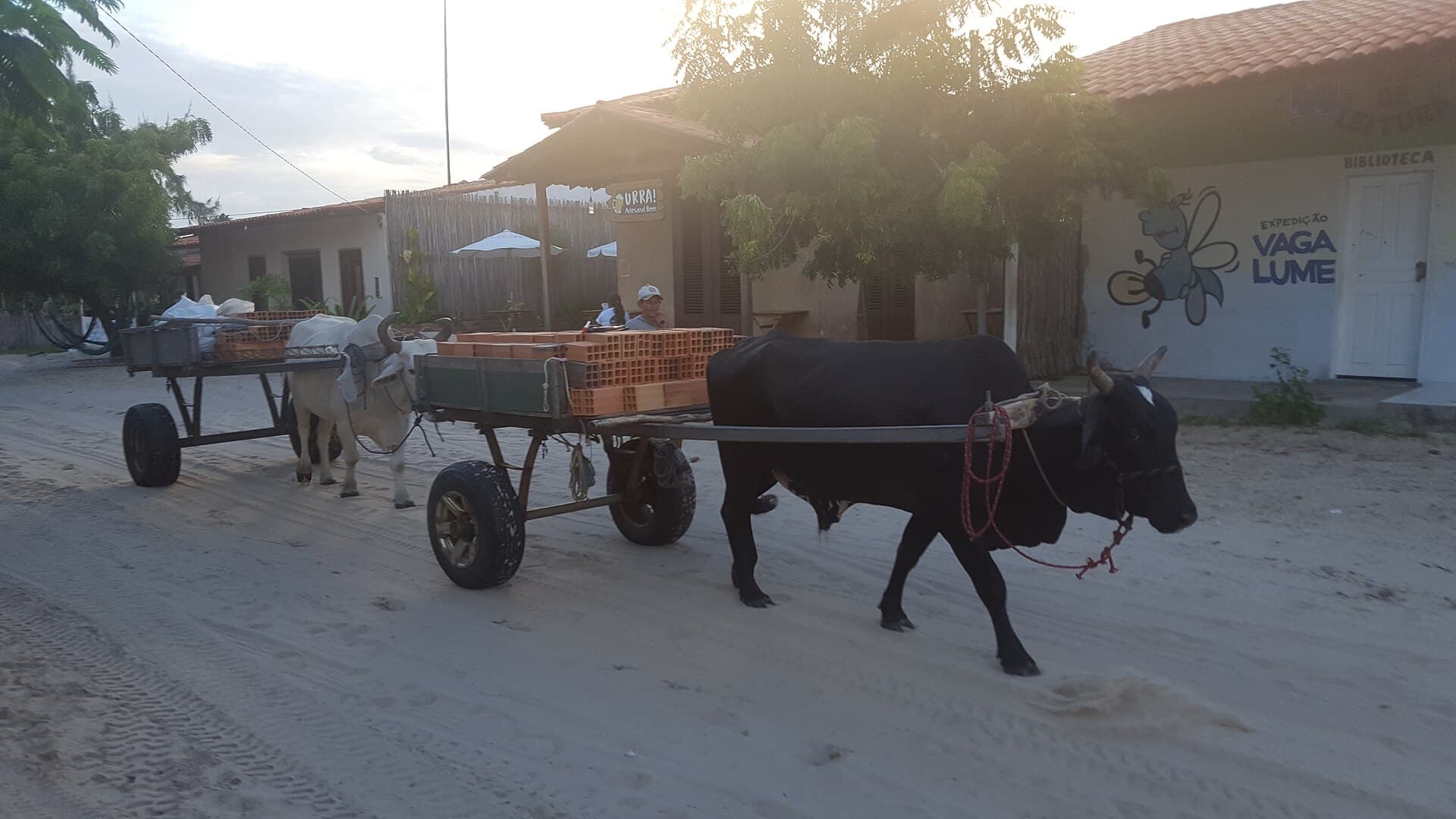
Atins: the pretty one. A fishing village of sand streets where the Rio Preguiças meets the sea, right against the eastern edge of the dune field, with a stretch of beach and a crop of small, well-designed pousadas that give it the feel of Tulum twenty years ago. The lagoons of the Canto do Atins are an hour's walk from the village, the wind blows from August to December and brings the kitesurfers, and the sunsets over the dunes are the best in the region. The costs of that charm: there is no bank or ATM, phone signal is bad on every network (Claro and Vivo are the ones that sometimes work), Wi-Fi in the pousadas comes and goes, and getting there is a small expedition.
To reach Atins from Barreirinhas you either take a boat down the river or a 4x4 along the beach. The shared speedboat leaves the Barreirinhas riverfront around 12:30 every day and takes between 40 minutes and an hour and a half, from about R$80 (about US$16) per person in 2026, with the return boats leaving Atins at 7am and 2pm; a private boat for up to ten people starts around R$500 (about US$100). The 4x4 leaves mid-morning, takes about an hour and a half through soft sand and flooded stretches, costs from about R$80 (about US$16) per person, and only runs when the tide allows. The nicest way to arrive is to book the Rio Preguiças boat day described below and ask for a version that ends in Atins instead of going back to Barreirinhas; several agencies sell it.
Santo Amaro: the quiet one. A small town on the western side of the park, about 240 kilometers from São Luís on a paved road (potholes included) and four hours away, a little longer door to door. This is where the dune field is widest and the lagoons are the biggest: the Lagoa da Gaivota, the Lagoa das Andorinhas and the Betânia and Emendadas circuits are all here, and on a good day in July you can have a whole lagoon to yourselves. The town itself is plain, with fewer restaurants, less English and a single Bradesco ATM, and it charges every visitor a tourism tax of R$10 (about US$2.00) per person, valid for three days, paid in person at the parking lot on the way into town (children under 12 and adults over 60 are exempt). Shared vans from São Luís cost from about R$130 (about US$26) per person in 2026, a private transfer from about R$1,000 (about US$200), and daily shuttles connect it with Barreirinhas, about 97 kilometers away, for around R$90 (about US$18) a seat.
Our recommendation, in short: four nights, stay in Barreirinhas and do the day tours. Five or six nights, spend three in Barreirinhas for the two lagoon circuits, then take the river boat day that ends in Atins and slow down. Santo Amaro is for a second visit, for the end of the trek, or for anyone who wants the emptiest dunes and does not mind the plainer town.
A few well-reviewed places to start with, all bookable on Booking.com:
- Pousada Casa do Professor (Barreirinhas): our personal pick for value for money. It sits on the river a short walk from the center, with its own deck and pier, river-view rooms and a generous breakfast.
- Hotel Pousada do Buriti (Barreirinhas): in the center of town a short walk from the river, with a pool, hammocks on the balconies and a big breakfast, and one of the best-reviewed places in Barreirinhas.
- Porto Preguiças Resort (Barreirinhas): the resort option, on the river about 2 kilometers from the center, with two pools and a gym. The one to book with children.
- Casa do Professor Hostel (Barreirinhas): a social and very affordable stay in the center, with dorm beds and private rooms, a garden that opens onto the river, a shared kitchen and breakfast included. Adults only.
- Pousada Eureka (Atins): garden rooms, a well-rated restaurant that also does dinner, and one of the highest review scores in the village.
- Pousada Lanea Experience (Atins): the upscale pick, with a bar, a proper breakfast and the beach a six-minute walk away.
- Pousada Vila das Lagoas (Santo Amaro): the most-reviewed pousada in town, with a pool, a restaurant and a playground.
- Hotel Pousada Rancho das Dunas (Santo Amaro): a pool, a restaurant, a tour desk, and consistently strong reviews.
What are the tours like, and what do they cost?
You cannot drive into the park, and you cannot wander in on your own. ICMBio, the federal agency that runs Brazil's national parks, allows visitors in only with credentialed guides in authorized vehicles, which in practice means the jardineira: a Toyota 4x4 truck with bench seats and a canvas roof in the back, packed with a dozen strangers. Your pousada or any agency in town books the seat, the truck collects you at the door, stops at a market so you can buy water, and the drive in is half the fun, with a ferry across the river and tracks that turn into ponds in June.
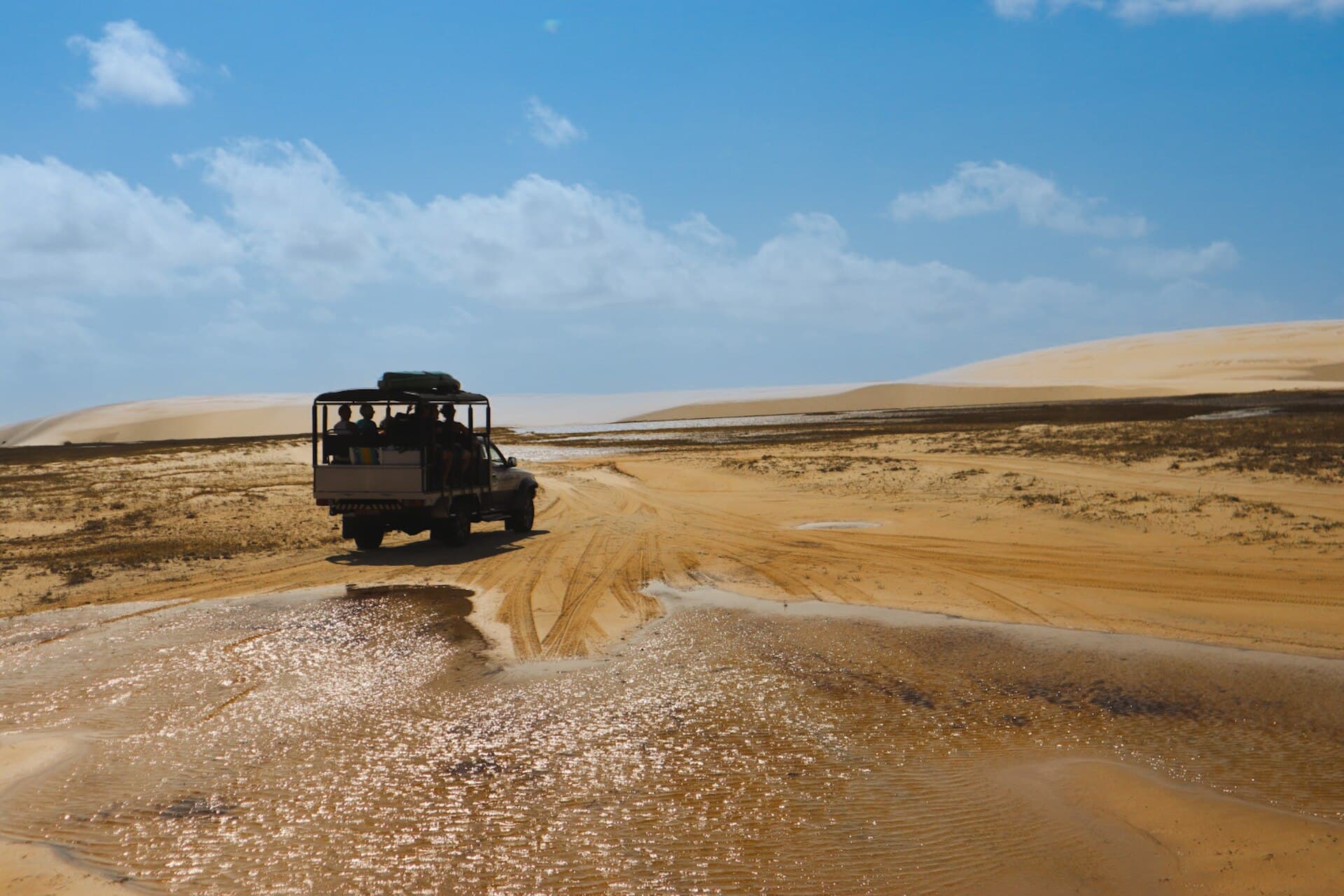
Prices below are the shared-truck rates agencies were quoting in 2026; a private truck for your own group costs several times more. Lunch is never included. Guides rotate the lagoons they visit depending on which ones are looking best that week, so the names you get may differ from the ones here.
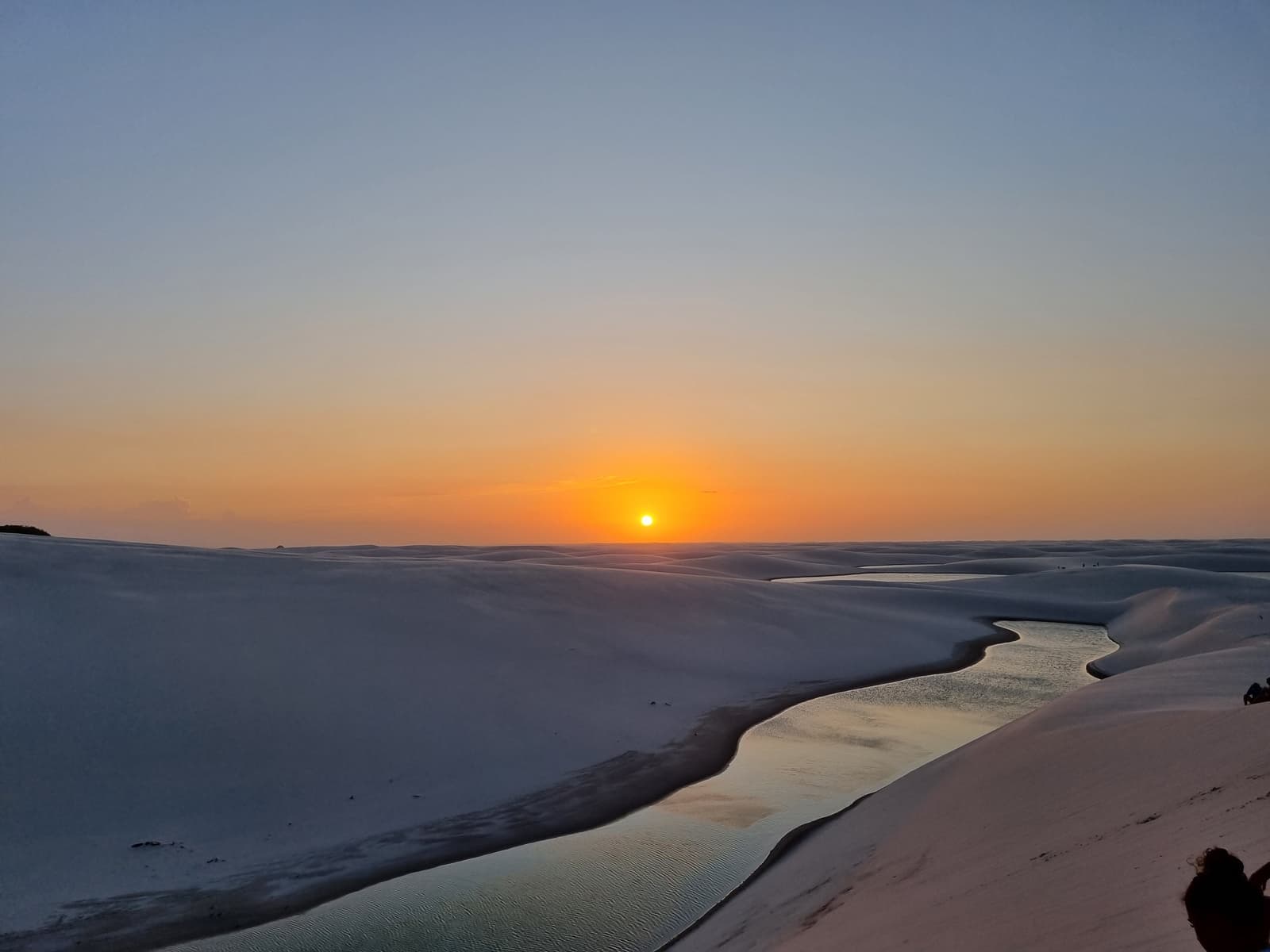
Circuito Lagoa Azul (from Barreirinhas). The classic, and the easier of the two Barreirinhas circuits. Trucks leave at 9am and 2pm, cross the Rio Preguiças on a small ferry, drive about 12 kilometers of sand track in 45 minutes, and then you walk a couple of kilometers between lagoons, stopping to swim in each: typically the Lagoa da Preguiça, the Lagoa do Peixe and the Lagoa Azul itself. About four hours in total, from around R$120 (about US$24) per person. The afternoon departure ends with the sunset from the dunes.
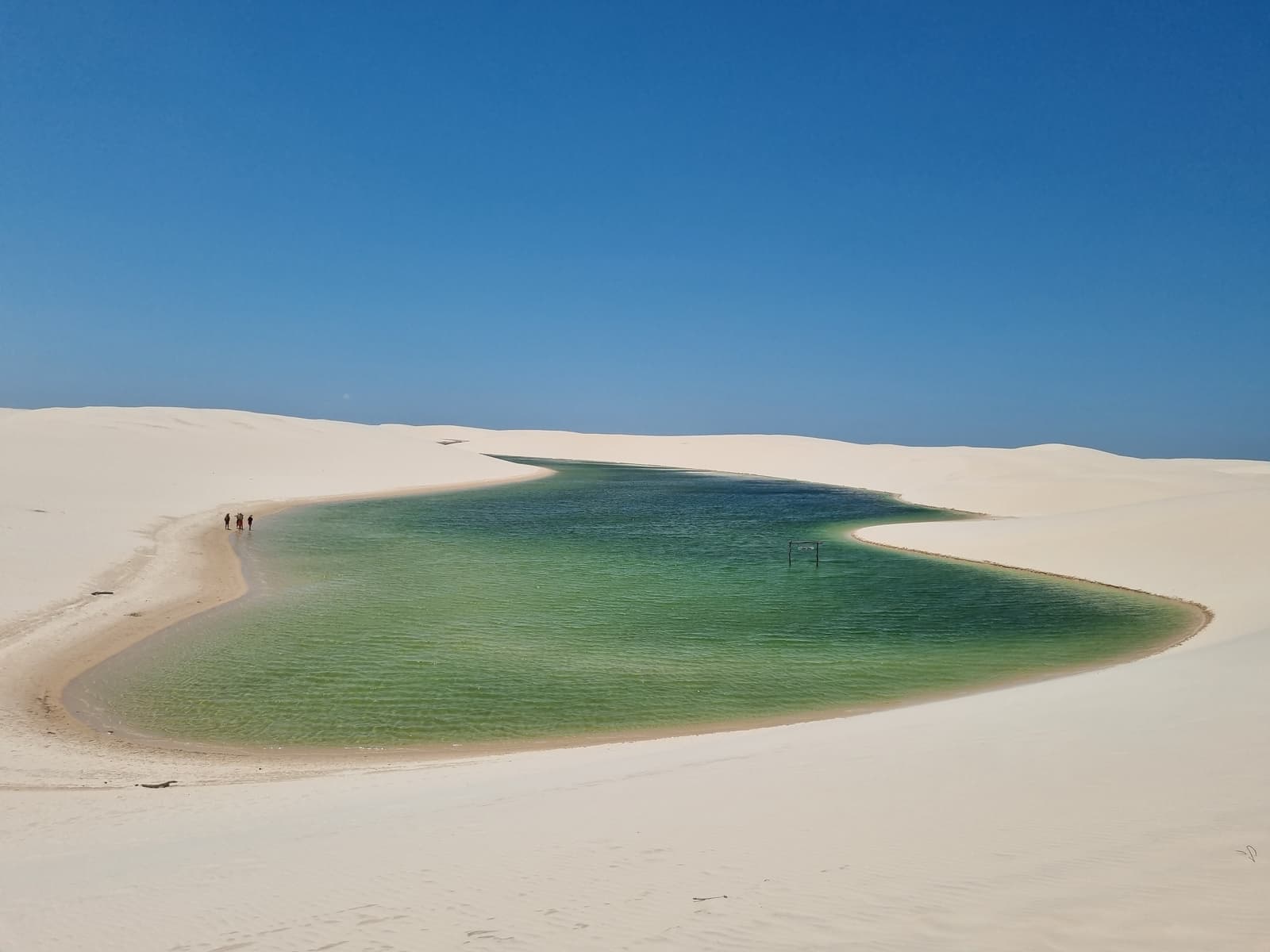
Circuito Lagoa Bonita (from Barreirinhas). If you only do one, do this one. Trucks leave around 1:30pm, drive about 15 kilometers in an hour, and then you climb a steep dune with a wooden staircase up its face. From the top the dune field opens out in every direction, with more lagoons than you can count, and you walk down to swim in a few of them (the Lagoa do Maçarico and the Lagoa Bonita among them) before climbing back for the sunset. About five hours, and the sunset is the point, so do not book the morning version. Around R$120–R$180 (about US$24–36) per person.
Agencies also sell the two as a full-day combo, Lagoa Azul in the morning and Lagoa Bonita in the afternoon, which is a lot of sun in one day but saves a night in town.
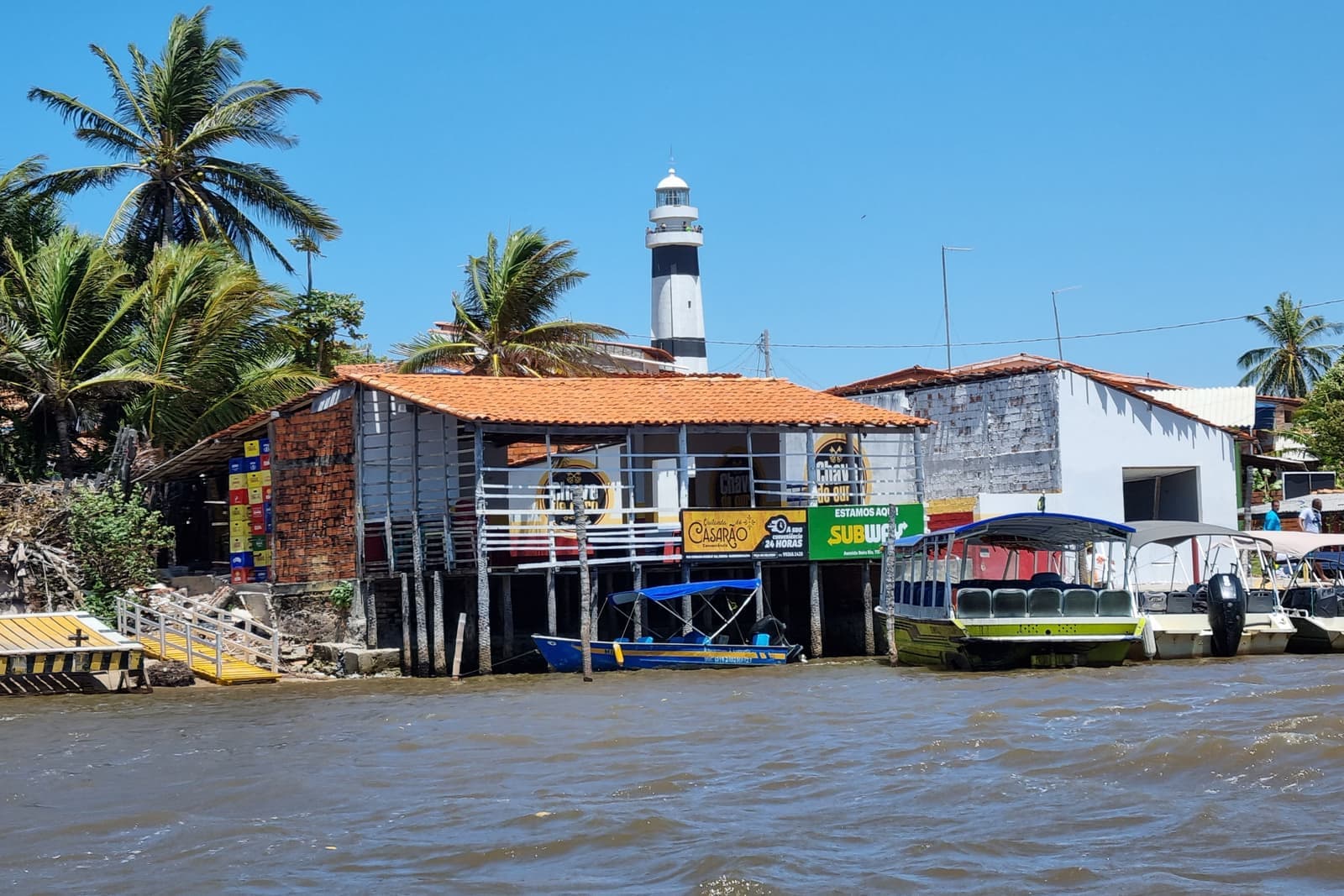
The Rio Preguiças boat day (from Barreirinhas). The other classic is not in the dunes at all. A voadeira, a fast open speedboat, leaves the riverfront around 9am and runs down the Rio Preguiças to the sea with three stops: Vassouras, where the "Pequenos Lençóis" dunes come down to the water and capuchin monkeys come down to the boats; Mandacaru, a fishing village whose 35-meter Farol Preguiças lighthouse you can climb for a view over the whole river mouth; and Caburé, a strip of sand between the river and the Atlantic with thatched restaurants where you stop for a fish lunch. You are back around 4pm. From about R$120 (about US$24) per person, lunch not included.
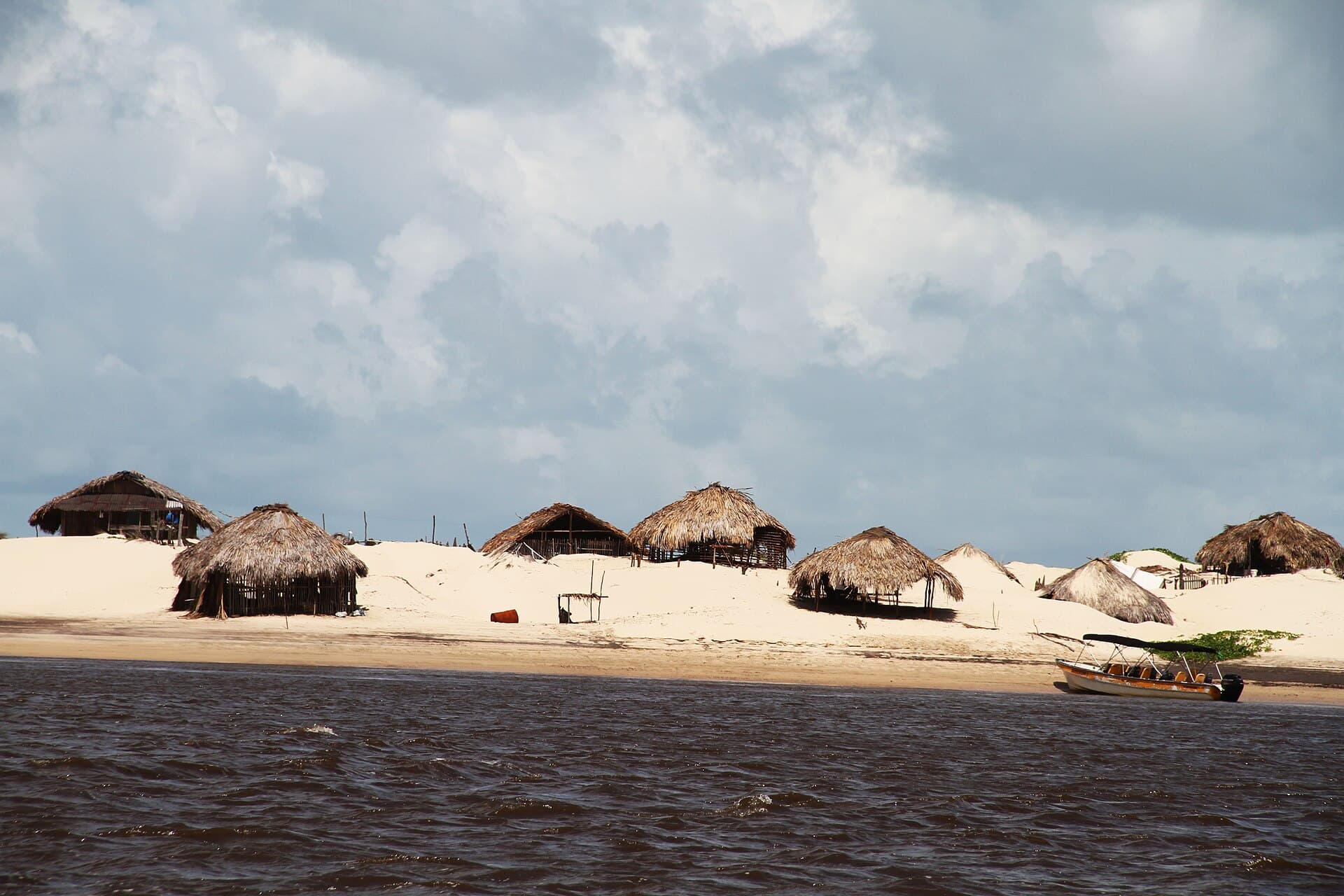
Circuito Canto do Atins (from Atins). Atins has its own circuit into the eastern lagoons, which the trucks reach in a few minutes along the beach. Tours leave at 9am and at 3pm, take three to five hours, and cost from about R$150 (about US$30) per person in 2026. The morning version ends with lunch at the Canto do Atins, a handful of houses in the dunes famous for one dish, grilled shrimp, served at the Restaurante da Luzia and the Restaurante do Antônio next door. You can also walk out from the village in about an hour and do it on your own, which is one of the pleasures of staying in Atins.
Santo Amaro's circuits (from Santo Amaro). The trucks from Santo Amaro run a morning circuit to the Lagoa da Gaivota and the Lagoa das Andorinhas, with a lunch stop in the village of Betânia, and a longer Betânia or Emendadas circuit into the biggest lagoons of the park. Expect to hand over R$10 (about US$2.00) in cash for a boat crossing on the way. Agencies in Barreirinhas also sell Santo Amaro as a day trip, out at 10am and back at 8pm for around R$250 (about US$50) per person in 2026, but it is a long day for what you get; if Santo Amaro's lagoons are what you want, sleep there.
A scenic flight. Small planes leave Barreirinhas airport from early morning and circle the dune field, and it is the only way to take in the scale of the place. In 2026 a 30-minute flight costs roughly R$870–R$950 (about US$170–190) per person and an hour about R$1,600–R$1,690 (about US$320–340), with a minimum of two or three passengers per flight. The light is best early in the morning and late in the afternoon, when the dunes throw shadows, and in July the seats sell out days ahead. Expensive, and we would still do it once.
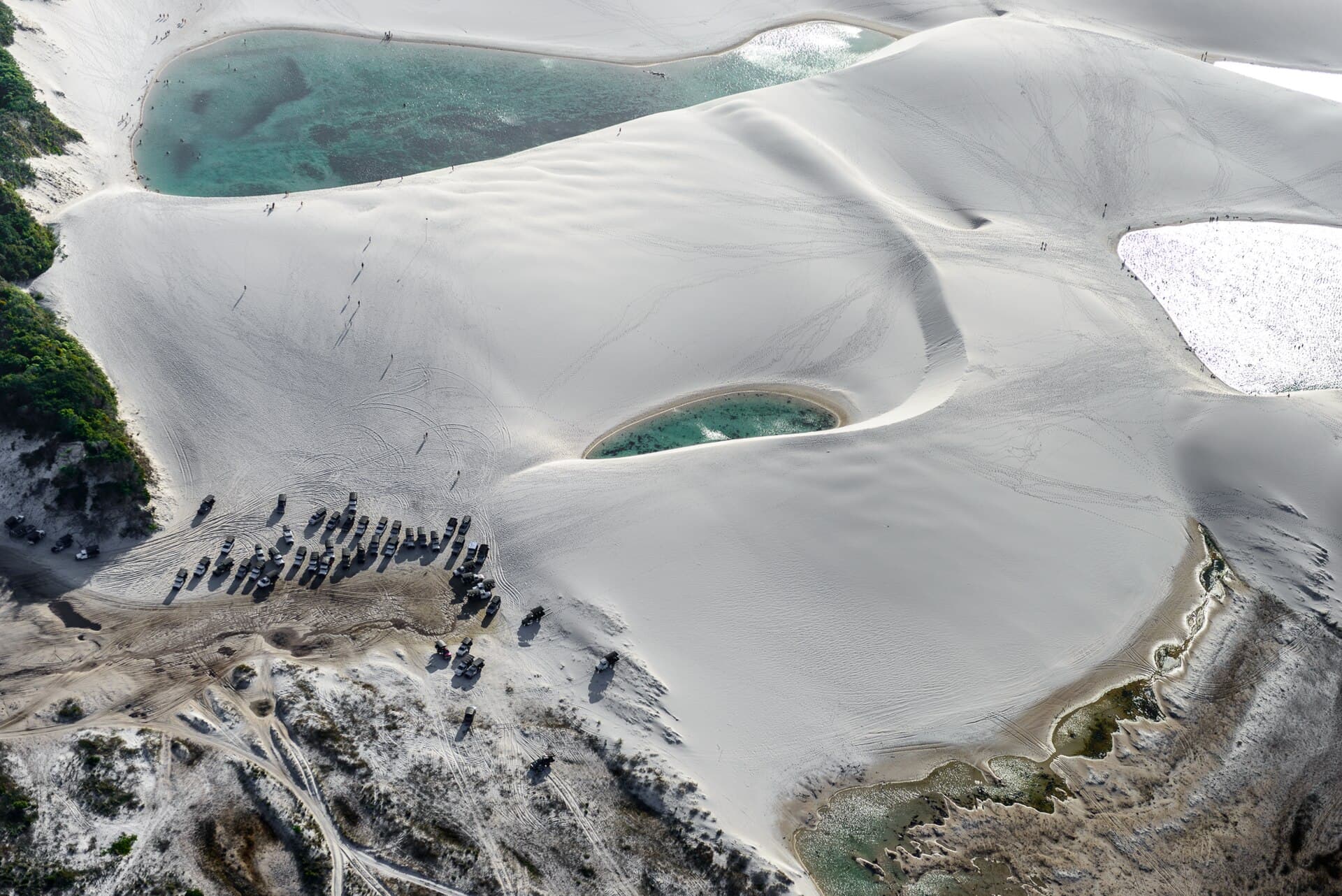
The crossing on foot. The Travessia dos Lençóis walks across the whole park from Atins to Santo Amaro over three or four days, about 39 kilometers in the classic three-day version (14, 17 and 8 kilometers), sleeping in hammocks in the homes of the oasis villages of Baixa Grande and Queimada dos Britos. You carry your own pack across open sand, start at dawn to beat the heat, and swim in lagoons nobody drives to. Guided packages with meals cost from about R$2,500 (about US$500) per person in 2026. The season is June to September, when the lagoons are full and the walking is wet enough to be fun.

Is there an entrance fee, and what are the park rules?
ICMBio charges nothing to enter the park, and it is open all year. What has changed is how tightly the visit is managed:
- Guides and vehicles are mandatory. Only credentialed guides and drivers in authorized vehicles may take visitors in. No private cars, no walking in on your own, no pets.
- New rules for treks since May 1, 2026. Groups are capped at ten people per guide, overnight walkers must book their beds at the community support points in advance and carry the proof for rangers to check, human waste tubes are compulsory on any trek with a night out, and glass bottles and campfires are banned everywhere in the park.
- A daily visitor cap is being studied. ICMBio is running a pilot to set a maximum number of visitors, which would most likely mean reservations for the classic circuits. Nothing was in force as of September 2026, but book through a registered agency and ask whether anything has changed.
- Drones need ICMBio authorization. Do not count on flying one.
- Keep the lagoons clean. Oils are banned in the water, and creams leave a film on it too. Put sunscreen on well before you swim and cover up with a sun shirt instead of reapplying at the water's edge.
- Santo Amaro's tourism tax is the town's, not the park's: R$10 (about US$2.00) per person for three days, paid on arrival.
Should you stop in São Luís?
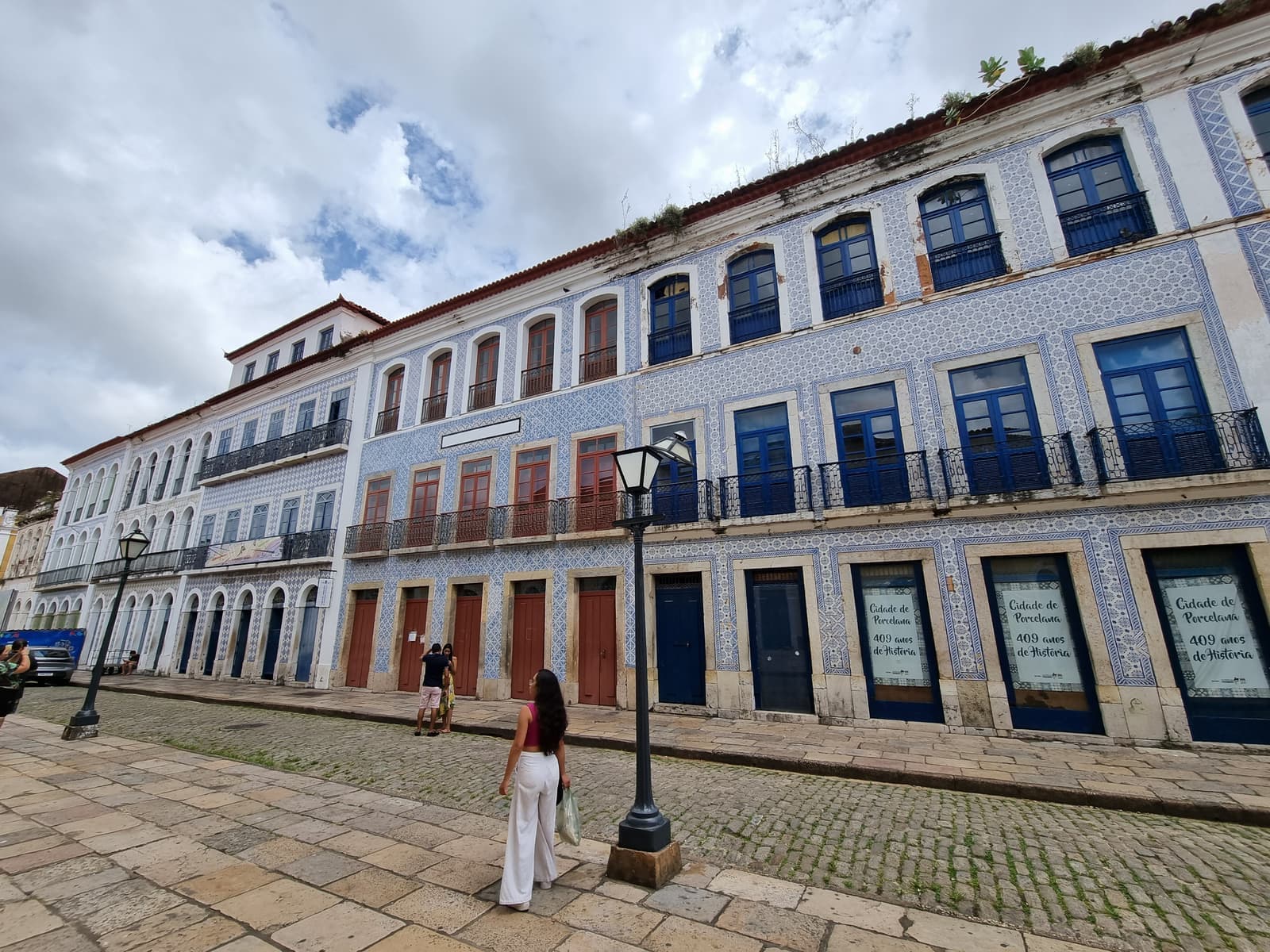
Most flights land in São Luís in the afternoon or evening, and the vans to Barreirinhas leave early, so a night in the city is often forced on you. Give it a full day if you can. The historic center, on the World Heritage list since 1997, is one of the best-preserved colonial centers in Brazil, with whole streets of mansions faced in blue-and-white azulejos (glazed tiles) and a reggae scene big enough that the city calls itself the Brazilian Jamaica. Eat arroz de cuxá (rice with sour vinagreira leaves, dried shrimp and toasted sesame), Maranhão's signature dish, and drink a pink Guaraná Jesus, the local soda. Treat the old center the way you would any Brazilian state capital, which means the busy streets in the evening and a ride door to door at night.
What should you know before you go?
- The sun is the main hazard. There is no shade on the dunes and the white sand reflects the light back up at you. Hat, sunglasses, a long-sleeved sun shirt and sunscreen are not optional, and the tour times exist for a reason: nobody walks the dunes at midday.
- Carry water. One to two liters per person per tour. Nothing is sold inside the park, and the trucks stop at a market on the way out of town.
- Sunset is at 6pm all year. This close to the equator the sun goes down around 6pm in every month, which is why the afternoon tours leave at 1:30pm or 2pm and never later.
- Bring cash and a card that works. Barreirinhas has bank ATMs and most places take cards and Pix. Atins has no ATM at all and Santo Amaro has one, so carry what you will need for boats, fees and beach restaurants. Visa and Mastercard are accepted far more widely than Amex. Our guide on paying and tipping in Brazil has the rest.
- Expect to be offline. Signal is fine in Barreirinhas and poor in Atins and inside the park. Download offline maps and your bookings before you leave the city, and see our guide on SIM cards in Brazil for which network to pick.
- See a doctor about yellow fever. Brazil's health ministry recommends the vaccine for the whole state of Maranhão, at least ten days before you travel. Bring repellent for the river villages at dusk.
- Dress for sand and water. Swimwear under light clothes, sandals or bare feet on the dunes, a dry bag for your phone, and nothing made of denim. A light rain layer if you come between January and May.
- The trucks are rough. Bench seats in the back and tracks that pitch the truck around. Fine for kids who like it, hard on bad backs, and the Lagoa Bonita dune is a steep climb even with the staircase; the Lagoa Azul circuit is the gentler one.
- Sockets run on 220 volts across Maranhão. Check your chargers against our guide to power plugs and voltage in Brazil.
The Lençóis reward the people who plan them. Pick a month when the lagoons are full, give the trip at least four nights, and let a guide drive you out over the last line of trees into a place that looks like nowhere else on the planet. Then climb the dune at Lagoa Bonita, sit down in the warm sand, and wait for the sun to go.
Want more practical tips for Brazil? Join our newsletter and get notified of our latest posts.